
Columbia Heights Directory Collections
Historical directory work in Columbia Heights begins by separating a confirmed local source from a nearby-city lead. No official source reviewed for this project verifies a complete, direct Columbia Heights city-directory run. The strongest local starting points are the Columbia Heights Public Library, the Anoka County Historical Society, Minnesota Historical Society collections, and map repositories. Hennepin County Library material can be useful, but its published directory scope is centered on nearby communities and Minneapolis, not a verified Columbia Heights run.
| Collection | Years or scope | Where held | Access |
|---|---|---|---|
| Anoka-area newspaper microfilm | Some Anoka-area papers begin in 1863; selected Columbia Heights Record issues | Anoka County Historical Society | Research visit or collection inquiry |
| Columbia Heights Pioneer and Record | Pioneer, January through November 1939; Record followed about a month later | Historical Society holdings | Selected issues and staff guidance |
| Hennepin phone books and city directories | Minneapolis 1859-1950, plus listed nearby-city runs | Hennepin digital collections and library access | Online where an item permits, otherwise library access |
| Sanborn Volume 7 | 1912 and last revised 1930 volumes include Columbia Heights and Fridley | University of Minnesota UMedia catalog | Online catalog and collection access |
A blank search in one volume is not a blank Columbia Heights history. It can mean the volume covers the wrong jurisdiction, the issue is not digitized, or the name is indexed under a spouse, business, predecessor locality, or street variant. Note: Record the repository and coverage statement before treating any directory hit as local evidence.
Columbia Heights City Directory Starting Points
The Columbia Heights Public Library at 3939 Central Ave N is city-owned and operated while participating in the Anoka County Library network. Its current phone is 763-706-3690. It is a practical place to ask about local reference help, nearby holdings, holds, and how to reach a source that is not on an open web page. Confirm current hours through the county library locations page before traveling.
The library has served the community since 1928 and contributes a World War II V-Mail and press-release collection through Minnesota Digital. That collection can supply a name-and-correspondence lead that a parcel or directory will not show. It does not turn a press mention into proof of residence. Treat the date, sender, recipient, and collection description as separate facts.
See the Minnesota Digital contributor page for Columbia Heights Public Library before searching its material.
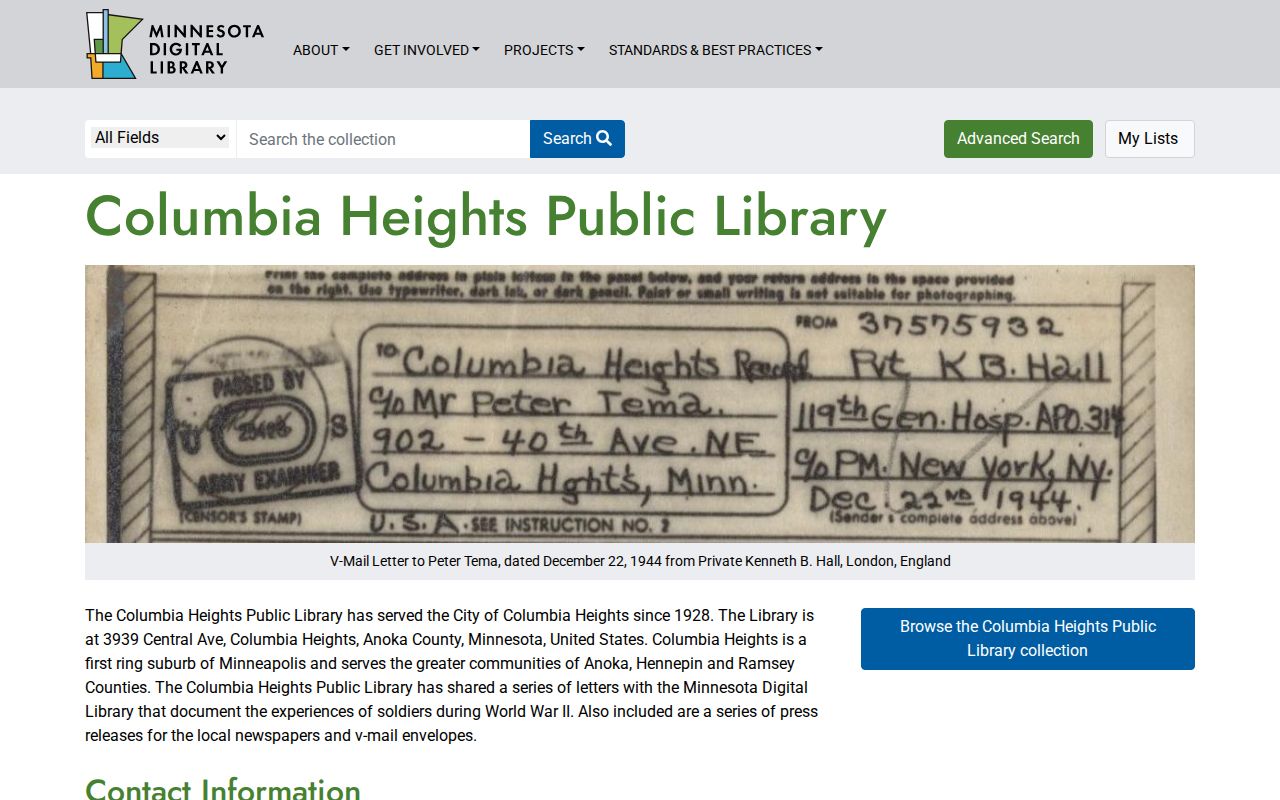
The contributor page is a useful reminder that Columbia Heights city-directory research can begin with correspondence and local collections, then move outward to newspapers and maps.
Columbia Heights Directory Boundary Check
Hennepin County Library Digital Collections has a Phone Books & City Directories collection that may be viewed, printed, or downloaded when an item allows it. Its published scope lists Edina from 1941-1977, Hopkins from 1942-1977, Minneapolis from 1859-1950, and St. Louis Park from 1933-1977. Those dates are valuable for a move across the county line, a nearby business, or an address that genuinely falls within the collection, but they do not verify a Columbia Heights directory sequence.
Use the historical address, owner surname, nearby Minneapolis street, or business name as a lead. Then test the jurisdiction printed on the scanned page. A Minneapolis directory entry may describe a Columbia Heights connection, but it should not be presented as a full Columbia Heights household listing without independent support.
Open the Hennepin digital collections to search the available directory items.
The collection interface helps locate a nearby-city item, while the item title and place of publication decide whether it belongs in a Columbia Heights trail.
Decode Columbia Heights Directory Entries
When a directory or reverse-address volume is located, read its key and title page before copying a name. Hennepin's house-history guidance explains that directory work can capture residents, occupations, spouses, businesses, and address access. The source does not establish that every Columbia Heights-related item uses every field, so preserve only the fields actually printed in the entry.
| Name form | Copy initials, spelling, suffixes, and any spouse reference exactly as shown. |
|---|---|
| Address or business | Separate a residence-style listing from a business location or a nearby-city address. |
| Occupation or organization | Use it as a clue for a newspaper, civic, or business search, not as an identity conclusion. |
| Reverse listing | When a volume has one, it starts from an address and may identify the household or business associated with that address. |
| Volume evidence | Keep the title, year, page, and repository with the transcription. |
- Criss-cross directory
- A reverse-address arrangement that groups listings by street or house number rather than surname.
- Householder index
- An index organized around the person or household named for an address, which may omit other people at that location.
- Abbreviation key
- The volume's own explanation of shortened words and marks. Photograph or transcribe it before interpreting entries.
For modern, address-keyed records after an old entry is understood, use the Columbia Heights street directory route rather than assuming the historic listing remains current.
Columbia Heights Pioneer and Record Story
The Anoka County Historical Society documents a particularly useful publication change: the Columbia Heights Pioneer ran from January through November 1939, then the Columbia Heights Record began about a month later. A surname search limited to the later title can therefore miss earlier 1939 notices. Search both titles, set a date range, and ask whether an apparently absent issue is unscanned or available only on microfilm.
This small publication shift matters because newspapers can supply the context a city directory lacks. An obituary, public meeting, business notice, church item, or street reference can identify a date and neighborhood for a later directory or map search. Selected Record issues do not equal complete yearly coverage, so cite the actual issue rather than an assumed run.
The Historical Society Vault describes the preservation context for these local issues.
The Vault material supports a two-title search for 1939, an unusually precise Columbia Heights research habit.
Columbia Heights City Directory Addresses on Maps
Old addresses often need a map before they need another name search. The University of Minnesota's Borchert collection includes a 1914 interactive Webb map and a 1916 Anoka County plat book. UMedia also identifies 1912 and last-revised-1930 Sanborn Volume 7 material that includes Columbia Heights and Fridley. Plats help translate an owner, lot, block, or subdivision into a street reference. Sanborn maps add building footprint, material, street name, and industrial context.
The records serve different roles. A plat is not a resident list, and a Sanborn map is not an ownership record. Together they can test whether an address in a Columbia Heights city directory was part of a subdivision, a commercial corridor, or an earlier place description. The city formed in 1898, so a pre-incorporation search should also test Fridley Township, the plat name, and Anoka County.
The Hennepin County Library online-resources page provides the companion directory-collection scope and house-history context.
Use a map date and an address date together, since the street and built environment can change between Columbia Heights records.
Columbia Heights Names in Archival Records
The Minnesota Historical Society finding-aid index lists Columbia Heights Municipal Court records: indexed civil and criminal dockets from 1920-1969, a judgment book from 1927-1929, and a police arrest register from 1926-1950. These are archival name sources, not a modern city directory and not a reason to publish sensitive details. Request the relevant record series, date, and access rule from Minnesota Historical Society staff.
The Anoka County Historical Society adds newspapers, obituaries, photographs, letters, diaries, census material, naturalization papers, church and civil records, vital-statistics indexes, cemetery material, maps, and microfilm. A result should carry its collection name and date. That practice keeps a directory-like name clue from being confused with a verified current address.
Review the Anoka County Historical Society research resources before requesting a specific newspaper, map, or census item.
The Historical Society's mixed holdings let a Columbia Heights name lead move from a newspaper or census reference to a map or archival record.
Trace Columbia Heights City Directory Households
A household trail is stronger when every appearance has a date and a record role. Start with the earliest known Columbia Heights name or address, then move through sources in time order. A disappearance can mean a move, death, omission, a changed spelling, or a volume that does not cover the city. Compare a directory-style lead with the census years available through Anoka County holdings and Minnesota Historical Society resources, then use newspapers or vital indexes to test a change.
- Write down the exact surname, address, business, and year already known for the Columbia Heights household.
- Search the appropriate directory or phone-book collection, preserving its title, place, year, and page.
- Check the Pioneer and Record title variants, plus Anoka County Historical Society newspaper and obituary material.
- Pair the date range with Anoka County census holdings and Minnesota Historical Society People Records.
- Use a 1914 or 1916 plat, then the 1912 or 1930 Sanborn material, to interpret the older Columbia Heights address.
- Record whether each appearance identifies an owner, household member, business contact, witness, or newspaper subject.
Later proof may require a different custodian. A marriage certificate comes from the county that issued the license, a divorce decree comes from the district court, and a modern parcel trail belongs with Anoka County. Note: Preserve the source role, because a historical directory entry does not by itself establish present residence.
Columbia Heights City Directory Citation Routine
A reproducible Columbia Heights city-directory note names the repository, collection, publication title, date, page or image number, and the exact address or name searched. For a newspaper, include the issue date and page. For a map, include the map title, edition or revision date, sheet or page, and the lot, block, or street reference. For an archive, keep the finding aid, box, reel, item, or record series.
That detail is especially important here because the local trail crosses city, county, adjacent-city, and statewide collections. It lets another family member or researcher recheck the match without turning a partial listing into a claim that cannot be supported. The Columbia Heights Library, Historical Society, Minnesota Historical Society, and University of Minnesota are the documented channels when a web search ends.